Contents and sources 3 sections
Key points
- The three games are dated 2025. The Hacker News post was shared on November 24 in Taipei.
Two folds before the flop
At 2:39 a.m. Taipei time on November 24, Hacker News user dluuuu shared a link inviting readers to watch language models play poker. It leads to MikeLuu99’s Poker Arena project. The post is new; the three games in the project’s results file are dated August 23, 2025.[1][2][4]
The accompanying screenshot catches the first hand before the flop. GPT-5 Nano has posted the small blind of five chips and GPT OSS 120B the big blind of ten. The pot stands at fifteen. Claude 3.5 Haiku and Gemini 2.5 Flash both have “folded” beside their seats. That is one instant at the table. The final scores live in a separate file.[3]
Scroll right and the winner changes
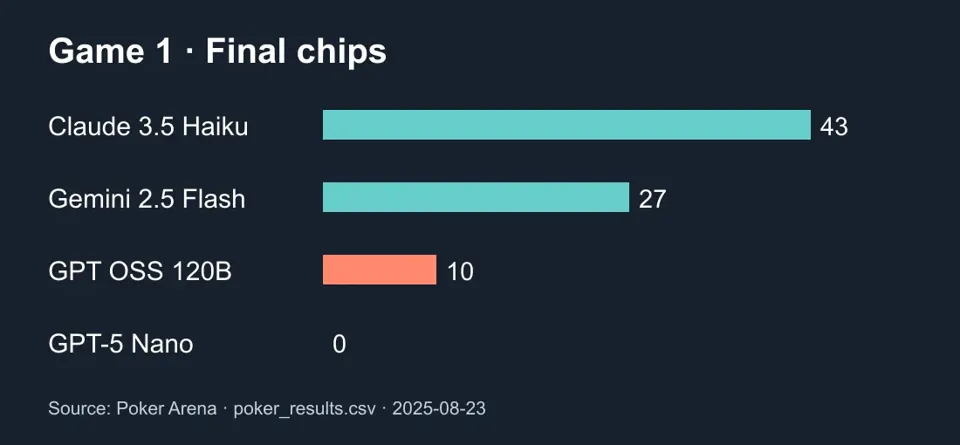
There are three rows in the results file. Find Game 1 and read the Winner column on the left: GPT OSS 120B, with ten chips at the end. Now scroll across to the individual rankings. Claude has 43 chips, Gemini 27, GPT OSS ten and GPT-5 Nano zero. Claude is listed first and labeled Winner. In this part of the row, GPT OSS places third.[4]
Count the names in the left-hand Winner column across all three games and GPT OSS takes two to Claude’s one. Award each game to the player who finished with the biggest stack and Claude takes two to GPT OSS’s one. Games 2 and 3 agree either way. A single row reverses the score between the two models.[4]
Who keeps the two sets of books?
The game tracks eliminated players. When it checks whether the tournament should end, it counts everyone still off that list. If just one player remains, it records their name as the winner along with their chip count. A separate routine ranks everyone by their final stack, largest first, and labels the player at the top Winner. Both records get their own space in the export.[5][6][7]
The row for the 17-hand game is enough to check who had 43 chips and who had ten. It doesn’t contain a complete hand history that would let a reader reconstruct when the two records diverged. If someone brings you this file as evidence of which model plays better poker, there’s a more interesting first question: which Winner are they pointing to?[4]
Sources & further reading
(7)
When checking a claim, compare the source date, measurement period and conditions. Some linked pages change over time.
- Let LLMs Play Poker · dluuuu (opens in a new tab)
- Poker Arena · README (opens in a new tab)
- Poker Arena · original table screenshot (opens in a new tab)
- Poker Arena · poker_results.csv (opens in a new tab)
- Poker Arena · tournament end condition (opens in a new tab)
- Poker Arena · ranking by final chips (opens in a new tab)
- Poker Arena · CSV export (opens in a new tab)
For information and education, not investment advice. Crypto assets are volatile. Verify independently.