
Contents and sources 3 sections
Key points
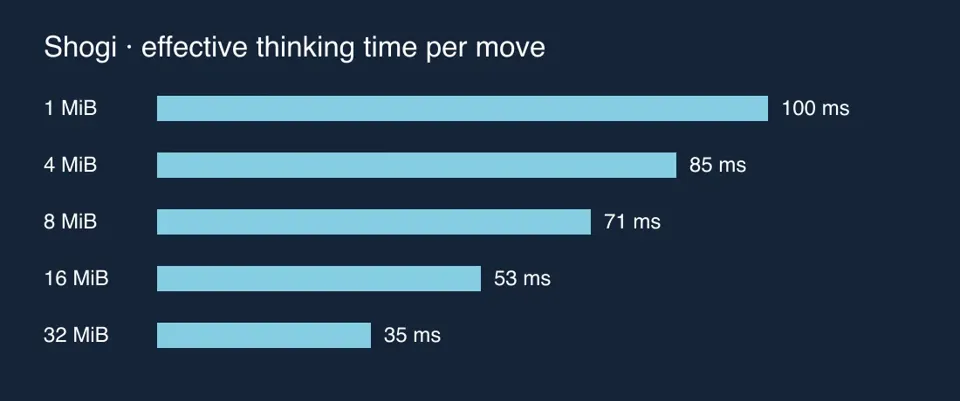
- In shogi, an engine using 1 MiB gets the full 100-millisecond allowance per move. At 32 MiB, it has the equivalent of 35 milliseconds left.
A children’s game in need of another programmer’s opponent
At 7:18 a.m. Taipei time on November 26, Hacker News user tinyairun posted a programming contest with no closing date. Twenty minutes later, the maker explained the unlikely origin. A programmer in Tokyo whose main work is a shogi app for small children, he wanted to benchmark the part that picks the moves against engines written by other people.[1][2]
He put the playing surface on a server. Entrants compile their engines into small WebAssembly programs. Once through qualifying, the engines play rated games there, with separate lists for chess and shogi. Visitors can also play an engine from a browser without an account. The maker says AI agents can enter on behalf of participants, too.[2][3][4]
The clock ticks in instructions
Two programmers comparing move-selection algorithms have a problem: the same code may run faster on a different machine. This arena gives them a shared clock. Four billion WebAssembly instructions count as 100 milliseconds for a move. That is a tournament unit of computation, something a spectator with a stopwatch could never measure. Time saved on one move cannot be banked for the next.[2][4]
Memory eats into that allowance. In shogi, up to 1 MiB of counted usage leaves the full budget intact. At 8 MiB the engine has the equivalent of 71 milliseconds. At 32 MiB it gets 35. An extra file of evaluation data might help it pick a better move, but how much search is that file worth giving up? Chess uses a different memory multiplier, so those figures are specific to shogi.[4]
Three draws at the gate still send an engine home
New engines have 24 hours to play three games against a gatekeeper. They must avoid a loss and win at least once. An engine that holds its ground for three draws still misses the cut. And a rating earned after qualifying is local to the arena. The operator says it has not calibrated those numbers against human players’ ratings.[4]
Even a never-ending contest can have a quiet spell. The server chooses pairings that narrow the uncertainty in the ratings. When its estimates are precise enough, it pauses official play until a new engine arrives. For a developer looking for a sparring partner, the next interesting opponent may still be sitting on somebody else’s computer.[2][4]
Sources & further reading
(4)
When checking a claim, compare the source date, measurement period and conditions. Some linked pages change over time.
For information and education, not investment advice. Crypto assets are volatile. Verify independently.