
Contents and sources 3 sections
Key points
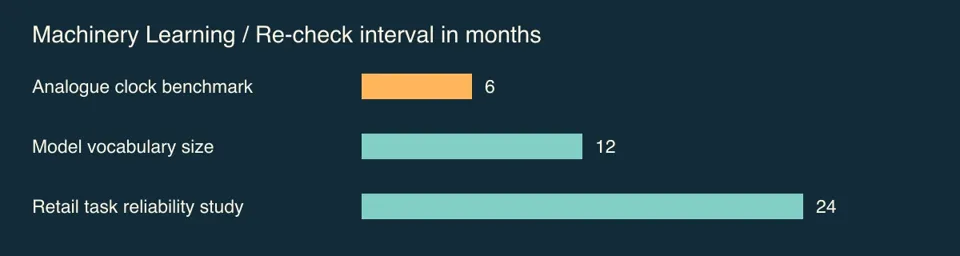
- The guide schedules a clock-reading benchmark for review after six months and a study of retail tasks after two years. Faded text means a check is due. The underlying claim might still hold up.
One “last updated” date can’t speak for a whole book
At 6:33 p.m. Taipei time on November 28, Robert Haist posted Machinery Learning to Hacker News as rhaist. He described it as years of research notes distilled into a free, open-source guide that he intends to update monthly. The site dates its launch to November 23. Today was its Show HN appearance. Its name borrows from Alan Turing’s 1950 paper “Computing Machinery and Intelligence.”[1][2]
For claims liable to change, Haist records the source, the last human check and the interval before the next one. A benchmark on reading analogue clocks gets six months. An entry about model vocabulary sizes gets twelve. A study testing whether an agent succeeds repeatedly on retail tasks gets twenty-four. If the date passes without another check, the claim fades on the page. A reader wondering about one particular number needn’t settle for the date at the bottom of the whole site.[3]
What did the firewall block? Fill the same blank 300 times
One chapter leaves an English sentence unfinished: “The firewall blocked the ___”. A connection, some traffic or a request would all fit. The demo takes scores from a small open model, SmolLM2-360M, and shows its eight likeliest next tokens, or pieces of text. Readers can draw once or ask for 300 samples at a time. A column alongside records how often each candidate turns up.[4]
The percentages have a denominator worth noticing. They represent shares among those eight candidates, not probabilities across the model’s entire vocabulary. Turn down the temperature and the favorites become more likely to win. Lower top-p and some candidates can turn grey, dropping out of the draw altogether. Sampling 300 times is 300 attempts at the same blank. It won’t write the next 300 tokens of a story.[4]
The monthly researcher can propose an edit. Someone else has to publish it
Haist also uses AI to maintain the guide. According to the site, a research agent checks a fixed list of sources each month and submits proposed edits with references on GitHub. A person reviews each change before it can be merged. Readers can flag errors from the end of a chapter and look up what changed in the monthly field notes.[2][5]
That gives the reader two quite different things to do with a doubtful answer. To see why a model might choose another word, move a slider and watch the counts. To see whether a number in the guide is still worth relying on, open its source entry and check the date. Even when an editor hasn’t made it back in time, the text can show its age.[3][4]
Sources & further reading
(5)
When checking a claim, compare the source date, measurement period and conditions. Some linked pages change over time.
For information and education, not investment advice. Crypto assets are volatile. Verify independently.