Contents and sources 4 sections
Key points
- The offchain vote cleared quorum. Changing pool settings takes onchain execution.
- On a $100,000 swap, the proposed reduction in the target fee is 43 times larger in one pool than in the other.
What the 136 ballots approved
Voting closed at 18:30 UTC on November 21, or 2:30 a.m. in Taipei on November 22. A November 23 check of Snapshot showed about 27.92 million in voting power for the proposal, comfortably above the 10 million quorum. No voting power went against or abstained. Snapshot recorded 136 ballots. The much larger headline number measures their combined weight.[1]
Uniswap Labs proposed six actions on November 16. The first five cover Celo, Soneium, X Layer, World Chain and Zora. Each network already collects protocol fees on v2 and v3. The plan would bring v4 into that system. The sixth action concerns a chain outside that list and a different set of recipients: the people supplying liquidity to two stablecoin pools on Arbitrum.[2]
Following the money from five networks to Ethereum
Under the plan, fees would accumulate in a contract called the TokenJar on each network. All five already have the collection infrastructure. The existing release process would route UNI earmarked for burning back to Ethereum mainnet and on to the burn address. An analyst tracing a payment would start with the assets collected locally and finish with the UNI received on mainnet.[2]
Those records need to be matched. A UNI transfer to the burn address on a given day, taken in isolation, cannot establish how much the expansion contributed. Coverage also has limits. The proposal explicitly excludes third-party hooks, the contracts that let pools customize how trades work. Adding a network would not automatically turn on fees for every such pool.[2][3]
A $100,000 swap makes the difference visible
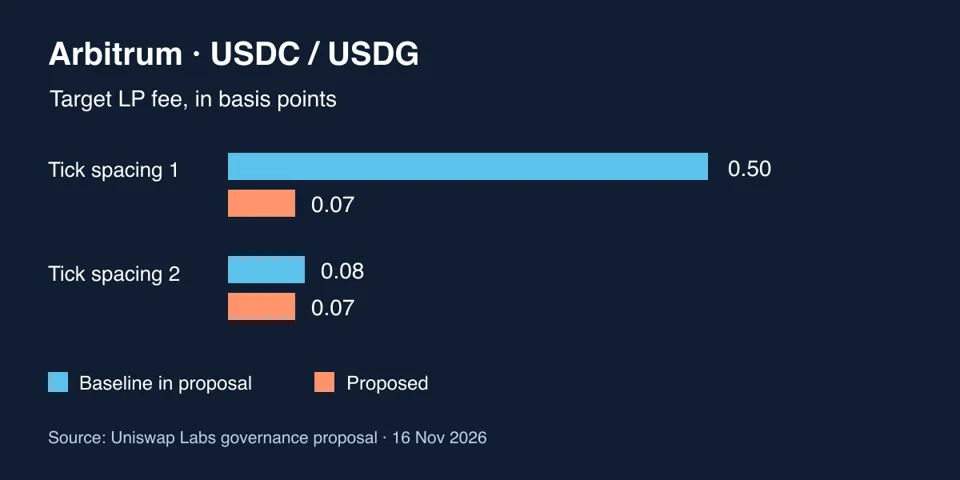
On Arbitrum the parameter in question is the target fee for liquidity providers, or LPs. Both pools trade USDC against USDG. One way to tell them apart is their tick spacing, the interval between usable price ticks. The proposal would cut the target for the tick-spacing-1 pool from 0.50 basis points to 0.07. For the tick-spacing-2 pool, the move is from 0.08 to 0.07. One basis point is one ten-thousandth.[2][4]
At the old targets, a $100,000 swap works out to $5 in the first pool and $0.80 in the second. The proposed target gives $0.70 in each. That is a $4.30 reduction in one pool and just $0.10 in the other. This calculation isolates the target fee. To find out which route actually delivers more USDG, a trader would need quotes for the same size at the same time, plus price impact and network costs.[2]
The next receipt to look for is on the destination chain
An offchain tally cannot change a pool setting. Labs put the companion fee-controller upgrade ahead of the expansion’s onchain vote. ETHBEAT, a delegate that backed the temperature check, said it still wanted to inspect the X Layer release path and final cross-chain configuration before committing to an onchain position.[2][3][5]
Arbitrum LPs have a specific contract to watch: the StablePair hook. If governance approves and executes the change, a message from Ethereum should update both pool configurations on Arbitrum. Comparing each pool’s actual volume and fee income over equal periods before and after that update would give LPs a first look at whether cheaper trades brought in more business.[2][6]
Sources & further reading
(6)
When checking a claim, compare the source date, measurement period and conditions. Some linked pages change over time.
- Protocol Fee Expansion: v4 on Five More Chains • voting results (opens in a new tab)
- Protocol Fee Expansion: v4 on Five More Chains (opens in a new tab)
- Upgrade the v4 Protocol Fee System (opens in a new tab)
- StableFeeConfiguration.sol (opens in a new tab)
- ETHBEAT delegate statement (opens in a new tab)
- StablePair hook on Arbitrum (opens in a new tab)
For information and education, not investment advice. Crypto assets are volatile. Verify independently.