
Contents and sources 4 sections
Key points
- The November 23 vote enactment approved administrative powers. Each market requires its own setup motion.
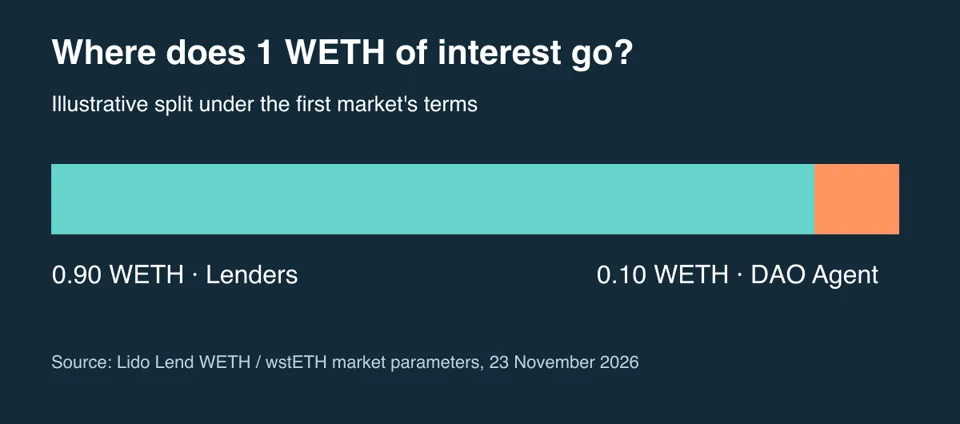
- For every 1 WETH of interest borrowers pay under the published terms, 0.10 WETH accrues to the DAO.
A governance vote and a first loan leave different records
By the November 25 review, Lido’s vote 207 had been enacted for two days. The DAO accepted administrative roles, approved mandates for three committees and registered six Easy Track factories for subsequent actions such as creating markets or changing settings. The voting page shows about 52.75 million in voting power in favor. That tells us how much support the proposal received. It tells us nothing about how much ETH people have supplied.[1][2]
Parameters published later on November 23 identify the assets on each side of the first Ethereum market. Lenders supply WETH, the wrapped form of ETH. Borrowers post wstETH, the wrapped form of Lido’s staking token. This pair has its own isolated market. Its activation requires a separate motion. Establishing when someone actually took a loan calls for a third piece of evidence: a borrow recorded against that market.[3][5]
A 5,000 WETH ceiling and a 90% utilization target
The initial supply cap is 5,000 WETH. Suppose lenders deposit just 1,000 WETH and borrowers take 900. Utilization reaches 90%. The market still has room for 4,000 WETH of additional supply, yet just 100 WETH of the original deposit remains unloaned. For someone trying to withdraw, it is the 100 WETH that matters.[3]
The rate model also uses 90% as its target utilization. At that target, the initial annual borrowing rate is set to 2.01%. The published ceiling on the borrowing rate is 4.47%. One sets a starting point and the other limits how far the rate can rise. Estimating lenders’ earnings takes two more observations: how much was actually borrowed and for how long.[3]
Ten percent of which payment?
On November 24, a Lido contributor explained that fees would be set market by market, taking account of assets, spreads and conditions at other venues. The first WETH/wstETH market specifies the fee base. For each 1 WETH of borrower interest, the DAO Agent receives 0.10 WETH and lenders keep 0.90 WETH. Filling the 5,000 WETH supply cap would not give the treasury a 500 WETH claim.[3][4]
To track actual income, distinguish the initial deposit from subsequent borrowing and interest accrual. The activation motion itself includes a minimal supply to initialize the market and vault. Seeing that deposit onchain would reveal little about outside lenders’ appetite. What counts for adoption is how much capital stays after activation and how much of it borrowers use.[3]
The 98% liquidation threshold uses an accounting price
The first market sets its liquidation loan-to-value threshold at 98%. Its oracle uses the protocol’s accounting rate for wstETH and values one stETH at one ETH. If stETH trades at a discount on secondary markets, an immediate sale may fetch less ETH than that valuation implies. The 98% threshold identifies when a position crosses the liquidation line. It cannot tell a lender how much WETH is immediately available to withdraw.[3]
The market rules make that distinction concrete. If the risk committee freezes the market, new borrowing stops and borrowers with open debt cannot withdraw collateral. They can still repay. Lenders may withdraw only to the extent that WETH remains unloaned. A useful companion to the next headline supply figure is the outstanding debt and the liquidity available at the very same block.[3]
Sources & further reading
(6)
When checking a claim, compare the source date, measurement period and conditions. Some linked pages change over time.
For information and education, not investment advice. Crypto assets are volatile. Verify independently.