
Contents and sources 4 sections
Key points
- All 49 ballots backed advancing the proposal. The onchain vote and execution still determine which terms go live.
- Risk analysts proposed halving the MSTRc supply cap and cutting the initial allowance for Anthropic’s ANTc to roughly $1 million.
Seven stock tokens in, one currency out
Aave’s Snapshot poll closed at 17:56 UTC on November 27, early Saturday in Taipei. Its 49 ballots carried about 387,176 voting units in favor, with zero against or abstaining. The original forum post named Netflix, Oracle, Palantir, AMD, ServiceNow and Strategy. The ballot added Anthropic as the seventh candidate for the Aave V4 Mag-7 lending market on Base, an Ethereum layer-two network.[1][2]
Aave introduced the first set of Coinbase stock tokens in a September 25 announcement and an accompanying X post. The expansion follows the same lending arrangement. A holder could deposit a stock token as collateral and borrow USDC. Someone holding USDC who wants to borrow stock tokens to sell short would need a different market.[4][5]
Which price does a lender see on Saturday?
The proposed feeds update from Sunday at 8 p.m. through Friday at 8 p.m., US Eastern time. Over weekends and US market holidays, the oracle carries forward the last quote. A token can change hands on Base while the lending market continues to read Friday’s price.[1]
Consider Strategy, which holds bitcoin on its balance sheet. If bitcoin sells off on Saturday, investors can immediately mark down the value of those holdings. An Aave account backed by MSTRc could still show the old stock quote. When the feed resumes, the first fresh price could bring a weekend’s worth of repricing into the borrower’s account at once.[1][3]
What changes for someone depositing $100?
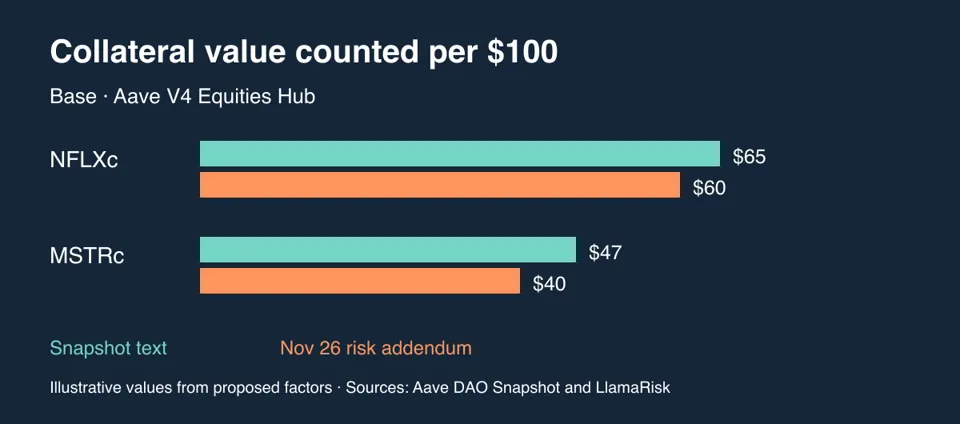
At the ballot’s 47% collateral factor, $100 of MSTRc at the oracle price would contribute $47 toward borrowing capacity. A November 26 risk addendum recommends 40%, so the same deposit would contribute $40. It also recommends moving Netflix’s NFLXc from 65% to 60%. What a borrower could actually draw would depend on the rest of the account and the USDC available.[1][3]
The analysts also proposed raising MSTRc’s maximum liquidation bonus from 6.5% to 8% and halving its supply cap from 41,298 to 20,649 tokens. The bonus gives liquidators more room to absorb price moves. The cap limits the number of tokens the market can accept in the first place. At the November 12 price used in the analysis, the smaller cap worked out to about $2.5 million.[3]
Where to look for the first deposits
For Anthropic’s ANTc, the analysts kept the collateral factor at 45% and recommended cutting the supply cap from 51,456 to 10,291 tokens. That works out to roughly $1 million at the November 19 debut closing price cited in the analysis. An allowance that size tells a reader how much collateral the market could accept. Actual deposits require people to send tokens after the market opens.[1][3]
The next document to check is the formal onchain Aave Improvement Proposal. Look for a deployed feed for each asset and check the executable parameters against the November 26 recommendations. Once execution lands on Base, two balances will tell the next part of the story. Stock tokens supplied measure collateral deposited. Outstanding USDC debt measures how much stablecoin borrowers actually drew.[1][2]
Sources & further reading
(5)
When checking a claim, compare the source date, measurement period and conditions. Some linked pages change over time.
- Seven-asset expansion · final ballot and tally (opens in a new tab)
- Expand Coinbase Tokenized Equities on Base (opens in a new tab)
- November 26 collateral and supply cap recommendations (opens in a new tab)
- Coinbase tokenized stocks on Aave (opens in a new tab)
- September launch announcement (opens in a new tab)
For information and education, not investment advice. Crypto assets are volatile. Verify independently.