Contents and sources 4 sections
Key points
- The proposed Main Spoke USDC add cap rises from 110 million to 150 million tokens.
- Borrowing has its own limit. A supply balance on its own says little about loan demand.
One balance of 97.1 million USDC, two valid percentages
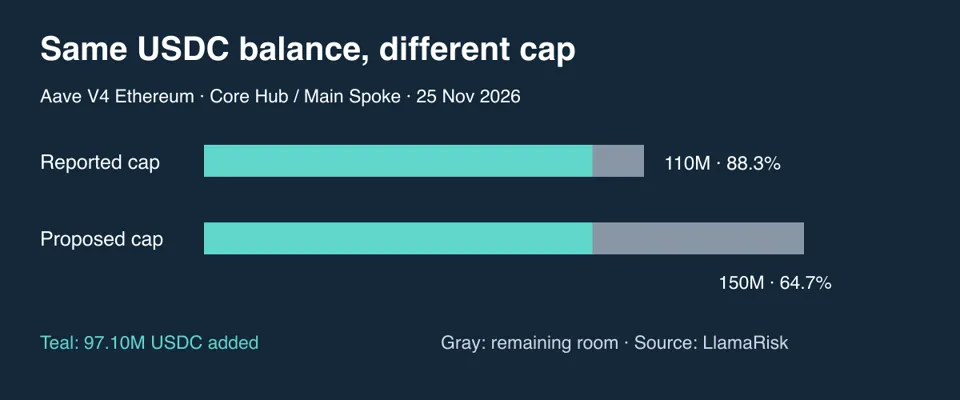
On November 25, risk researcher LlamaRisk published seven proposed cap changes in Aave’s governance forum. One concerns the Main Spoke of the Ethereum Core Hub. Its review recorded 97,104,336 USDC added to the hub through that spoke, or 88.3% of the 110 million limit reported at the time.[1]
That left room for another 12,895,664 tokens. Apply the proposed 150 million ceiling to the very same balance and the headroom becomes 52,895,664. The difference is exactly 40 million USDC. In the chart, the teal bar represents the same funds in both rows. The longer gray segment measures capacity a future supplier could use.[1]
Supplying and borrowing each have a gate
Aave V4 users supply or borrow through modules called spokes. A hub manages the shared liquidity. Each spoke has limits for each asset. The add cap governs how much it can supply to the hub, while the draw cap governs how much it can draw from the hub. To interpret either number, identify both the spoke and the direction of the transaction.[2]
The Main Spoke owed 49,050,321 USDC in the review. Against its reported 85 million draw cap, that used 57.7% of the allowance. The proposed 100 million limit would take the same debt to roughly 49.1% of the cap. Both calculations divide by a borrowing allowance. The utilization relevant to interest rates uses a different denominator: actual borrowed liquidity relative to total liquidity.[1][2]
Another spoke was already using four-fifths of its USDC line
The Bluechip Spoke also draws USDC from the Core Hub. The review recorded 7,240,444 tokens owed against a 9 million limit, about four-fifths of the line. LlamaRisk recommended raising it to 15 million. Looking at that spoke separately reveals which group of borrowers was closer to exhausting its allowance.[1]
Caps also tell you little about who might withdraw. The review found that the three largest USDT supply positions on the Main Spoke held about 57% of that reserve, even though only 66.6% of its add cap was in use. Raising the limit alone leaves the depositors’ shares unchanged. Someone assessing withdrawal pressure needs both figures.[1]
The next record to look for is the parameter-change transaction
As of the November 26 morning review in Taipei, the forum documented a recommendation and the balances behind it. LlamaRisk disclosed that it receives some funding from the Aave DAO and said the updates would go through the Risk Steward process. To verify implementation, match the transaction hash, asset, hub and spoke on the parameter dashboard. An update to another USDC line would answer a different question.[1][3]
Even a confirmed transaction would establish only that capacity changed. To trace the money, follow deposits and withdrawals at the same spoke over a defined interval after the change. Track borrowing and repayments separately. Reconciling those flows with the balances would show how much of the extra 40 million USDC in headroom depositors actually used.[2]
Sources & further reading
(4)
When checking a claim, compare the source date, measurement period and conditions. Some linked pages change over time.
For information and education, not investment advice. Crypto assets are volatile. Verify independently.