
Contents and sources 4 sections
Key points
- The first service quarter runs from September 30 through December 29, with payment in arrears.
- The mandate covers up to 50 Comet deployments. The Foundation and other providers lead some of the strategic work.
Fourteen ballots approved a year’s budget
Voting closed at 17:49 UTC on November 26, or 1:49 a.m. in Taipei on November 27. Snapshot recorded 14 ballots carrying roughly 727,449 COMP in favor, above the 400,000 quorum. No voting power went against or abstained. The ballot count measures participation, while voting power determines whether the proposal clears the threshold.[1]
What passed was a service budget. Under the proposal, the Treasury Management Committee (TMC) pays from funds it already administers. The tally establishes the mandate and its terms. Dating an actual payment to Gauntlet requires a separate record of USDC leaving the treasury.[1]
Where the first $76,000 fits
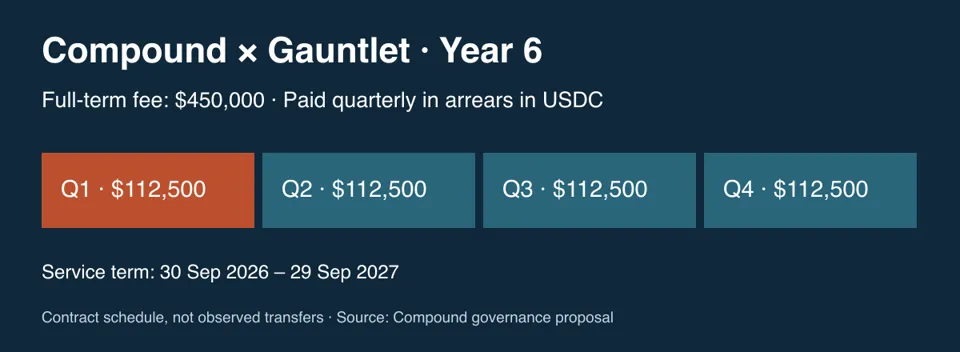
Gauntlet said it kept working after the previous engagement ended. Year six therefore runs retroactively from September 30, 2026, to September 29, 2027. The fixed annual fee is $450,000, payable in USDC in four installments of $112,500 after each service quarter. The first quarter ends December 29.[1]
The proposal also mentions roughly $76,000. That is its daily prorated estimate for service from September 30 through November 30 and is included in the first $112,500 installment. Either side can terminate on 60 days’ written notice. A partial final quarter is prorated through termination, and unpaid funds stay under TMC control.[1]
The two annual fees cover different jobs
The Compound Foundation backed the renewal and pointed out that the prior $2.3 million fee included an insolvency fund. Year six refocuses Gauntlet on up to 50 deployments of Comet, Compound III’s lending markets. Treasury work moves under the TMC, and the Foundation and other providers lead strategic projects such as V4. Gauntlet remains a signer on the TMC multisig and can advise on the risk of treasury allocations.[1][2]
Delegates disagreed over procurement. AranaDigital valued continuity and the team’s familiarity with existing markets. Forum participant cmrn wanted a competitive request for proposals before renewing. The final poll recorded zero opposing voting power, but the forum preserves a substantive objection to the selection process.[3][4]
What delivery looks like before an invoice arrives
For borrowers and suppliers, the work shows up in the details: collateral limits, interest-rate curves and the amount a market can accept. The mandate calls for weekly routine parameter reviews, monthly interest-rate reviews and daily refreshes of a public risk dashboard. Gauntlet recommends changes. The record of a particular market’s governance or execution shows when its settings actually changed.[1]
There are two opportunities to check delivery against the budget. During the quarter, look for reports and parameter recommendations on schedule. After the quarter closes, look for the matching USDC payment from the TMC. That ties each treasury movement to a period of service and keeps a full year’s budget out of the vote day’s cash-flow figure.[1]
Sources & further reading
(5)
When checking a claim, compare the source date, measurement period and conditions. Some linked pages change over time.
For information and education, not investment advice. Crypto assets are volatile. Verify independently.