
Contents and sources 4 sections
Key points
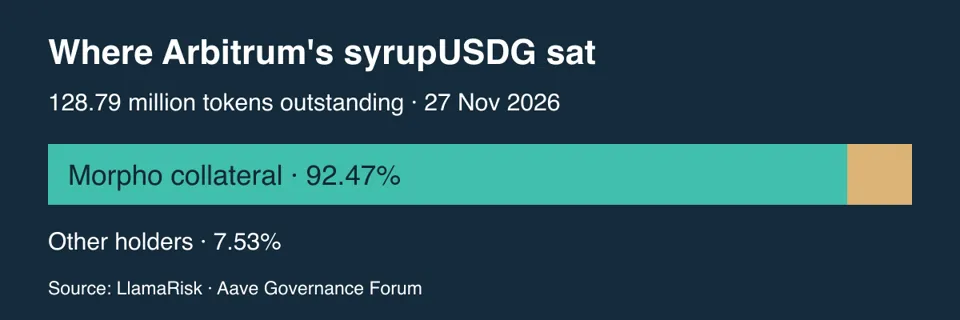
- On November 27, Morpho held 92.47% of Arbitrum’s syrupUSDG as collateral. Aave liquidators could end up competing with Morpho liquidators for the same buyers.
- LlamaRisk wants an intercompany loan repaid and closed, plus a written commitment from Maple to keep its syrup pools financially separate.
One local market for two sets of liquidators
A unit of Maple’s syrupUSDG represents a share in a lending pool. As the pool earns income, each share can claim more USDG. LlamaRisk counted 128.79 million tokens on Arbitrum on November 27, including 119.09 million posted as collateral on Morpho. Those are balances at a point in time. Measuring net inflows would require a starting balance and a period to compare.[1]
Aave is considering accepting the same asset on V3 Arbitrum. If borrowers on both protocols faced liquidation at the same time, anyone selling seized tokens locally for USDG would head to the same Uniswap v4 pool. Its $995,000 valuation counted both assets. Treating all of it as USDG available to buyers of the collateral would overstate the cash on the other side of the trade.[1][2]
Ninety-four swaps tell us what traded. How big an order could clear?
LlamaRisk examined 94 swaps from October 8 through November 27. After each trade, the pool price ranged from 0.23% below to 0.24% above the underlying exchange rate. About $1.01 million traded across 26 active days. Those observations describe the orders that actually went through. A liquidator looking to place a much larger order needs a quote for that size.[1]
Using November 27 market depth, the assessment estimated that a holder could sell about 788,000 syrupUSDG, worth roughly $800,000, within 4% price impact. The date and the tolerated price move belong alongside the figure. If a liquidity provider pulls capital before the next liquidation, an order of the same size can fetch a different price.[1]
The alternative takes a bridge and a redemption queue
A holder can burn syrupUSDG on Arbitrum through Chainlink CCIP and receive the corresponding locked tokens on Ethereum. Redeeming those shares for USDG then requires passing Maple’s permission checks and entering its withdrawal queue. Among 770 historical Ethereum requests reviewed by LlamaRisk, the median processing time was 3.2 minutes. The longest took 34.8 hours. Neither figure includes the bridge trip.[1]
On November 28, forum participant Zealynx asked which Ethereum exchange rate the Arbitrum price feed carries. If a loan is impaired, would the feed and the redemption contract make the same deduction for unrealized losses? The question concerns the contracts in use after an upgrade. Establishing whether a valuation gap exists would require confirming exactly what the feed reads.[3]
The $21.14 million loan to check before listing
The syrupUSDG pool lent USDG to a Maple-owned borrower that held the proceeds in another Maple product, syrupUSDC. On November 27 the loan still had $21.14 million of principal outstanding. Under simultaneous withdrawal pressure, the borrower could have to wait in the syrupUSDC queue before returning cash to the syrupUSDG pool.[1][4][5]
LlamaRisk made its support conditional on repayment and closure of the loan, with zero outstanding principal and no syrupUSDC left at the borrower address. It also wants Maple’s written commitment that its syrup pools will not fund one another while syrup assets are listed on Aave. The loan and borrower records below let readers follow the first condition. Checking how much a liquidator could sell on Arbitrum still requires a separate look at the local pool.[1][2][4][5]
Sources & further reading
(6)
When checking a claim, compare the source date, measurement period and conditions. Some linked pages change over time.
- syrupUSDG on Aave Arbitrum · risk assessment (opens in a new tab)
- Arbitrum asset listing proposal and recommended parameters (opens in a new tab)
- Question on exchange-rate accounting after impairment (opens in a new tab)
- Intercompany loan contract 0xb695 (opens in a new tab)
- Maple borrower wallet 0xBE8F (opens in a new tab)
- How Aave assesses collateral before listing on Base (opens in a new tab)
For information and education, not investment advice. Crypto assets are volatile. Verify independently.